What to know about Massachusetts’ new electricity rates for heat pump users.
WBUR/Updated August 25, 2025 Miriam Wasser
Using an electric heat pump in Massachusetts is about to become more affordable.
Beginning in November, the state’s three big electric utilities — Eversource, National Grid and Unitil — will offer cheaper electric rates during the coldest months of the year for households that use a heat pump.
The new seasonal rate is meant to encourage more customers to switch to heat pumps, which are a cornerstone of Massachusetts’ plan to tackle climate emissions. By 2030, the state aims to have 500,000 heat pumps installed. For context — just over 90,000 homes in the state had a heat pump as of last year.
With the winter heating season right around the corner, here’s what you need to know about the rates and how to sign up:
How much will I save?
Even without the new rate, households that replace an oil or electric baseboard heating system with a heat pump will almost certainly save money. But the savings are less certain for the many households that use natural gas.
“Part of the reason it has been difficult to get owners to switch from gas to electric is that the math hasn’t always penciled out in terms of cost savings,” said Kyle Murray, Massachusetts program director for the Acadia Center, a nonprofit that advocates for clean energy policies. Murray said the new winter rates “will likely make heat pumps significantly more affordable.”
A recent report commissioned by several environmental groups, including the Acadia Center, found that with the new rates, 64% of households would reduce their heating bill by installing a heat pump. The Department of Public Utilities, which ordered the utilities to implement these rates, said the average household with a heat pump should save about $540 this winter.
Heating costs depend on several factors — most notably usage and the weather. But in general, the utilities designed these rates so a person heating a home with a heat pump will pay the same, if not less, than a person who heats with natural gas.
How do the rates work?
From Nov. 1 to April 30, customers enrolled in the heat pump program will get a discount on the delivery portion of their bill.
For National Grid and Unitil customers, the change just affects the “distribution charge,” which is the cost of the poles and wires needed to get power to your house.
Eversource customers will see a reduction in the distribution and transmission charge. The transmission charge reflects the cost of building and maintaining the high voltage transmission lines that move electricity over long distances.
The distribution and transmission charges return to standard levels from May 1 to Oct. 31.
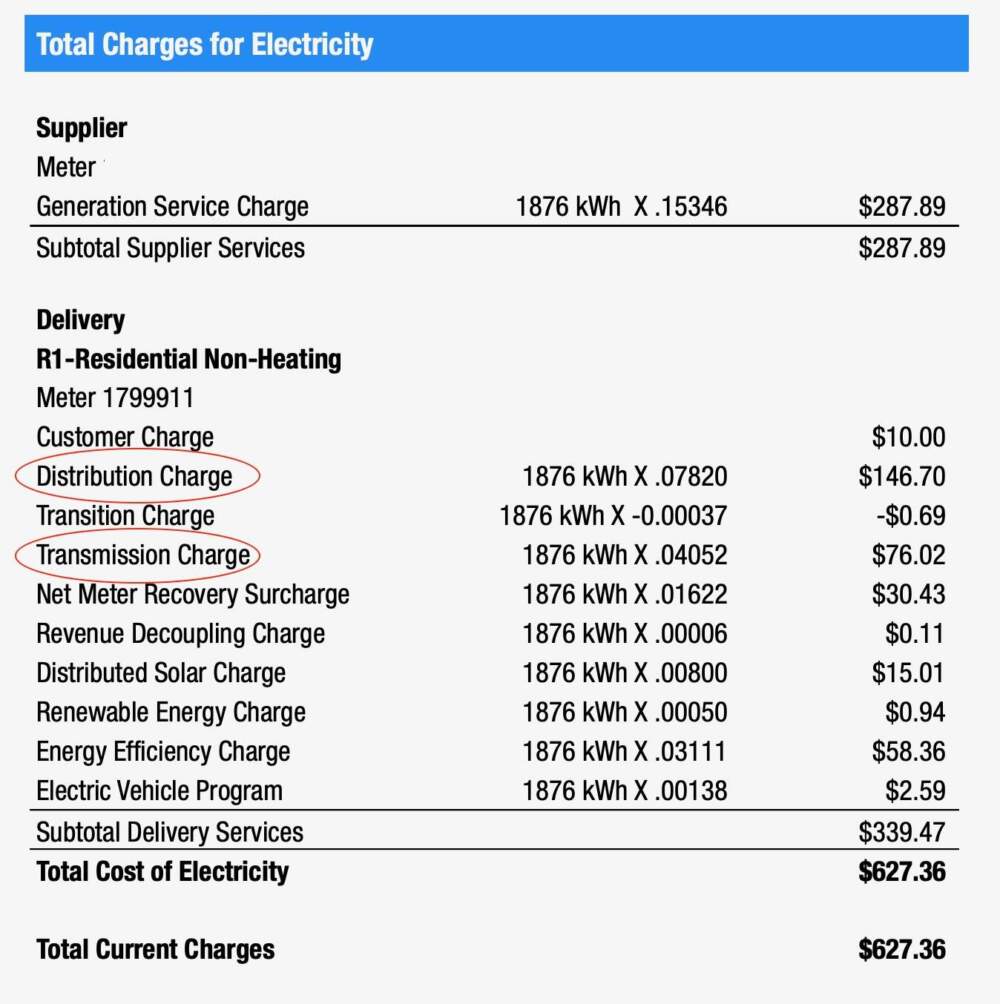 Beginning Nov. 1, 2025, heat pump owners will be charged a lower “distribution” rate during the coldest months of the year. (An Eversource bill with annotation by Miriam Wasser/WBUR)
The new seasonal heat pump rates vary by utility and will change every year. But going into this winter, here’s what you can expect. (Some of these numbers are subject to final approval from the Department of Public Utilities.)
Eversource
- Typical distribution rate: 6.26 cents per kilowatt-hour (kWh)
- Heat pump rate: 1.95 cents/kWh
- Typical transmission charge: 4.54 cents/kWh
- Heat pump transmission charge: 1.41 cents/kWh
National Grid
- Typical distribution rate: 6.74 cents/kWh
- Heat pump rate: 2.46 cents/kWh
Unitil
- Typical distribution rate: 10.18 cents/kWh
- Heat pump rate: 3.63 cents/kWh
To make sense of these numbers, let’s take a look at a real Eversource electricity bill from December 2024. It’s for a single-family home that uses heat pumps for space and water heating, and has an electric vehicle that gets charged at home.
In December, the family used 1,876 kilowatt hours of electricity and paid $627. Had the new heat pump rate been in effect, the total bill would have been more like $493 — a 21% savings.
Who is eligible?
If you receive a bill from Eversource, National Grid or Unitil and have a qualifying heat pump in your home, you should be eligible. (This includes people enrolled in a municipal aggregation program.)
People who live in a city or town served by a municipally-owned electric company are not eligible.
Which heat pumps qualify?
Pretty much all of them. Ducted system, ductless systems (mini splits) and for some customers, heat pump water heaters qualify.
Even if you don’t heat your entire house with a heat pump — maybe you only have mini splits in your finished basement or attic — you should be eligible.
If you got your heat pump through the Mass Save program in the last couple of years, you almost certainly qualify — in the future, you may even be automatically enrolled.
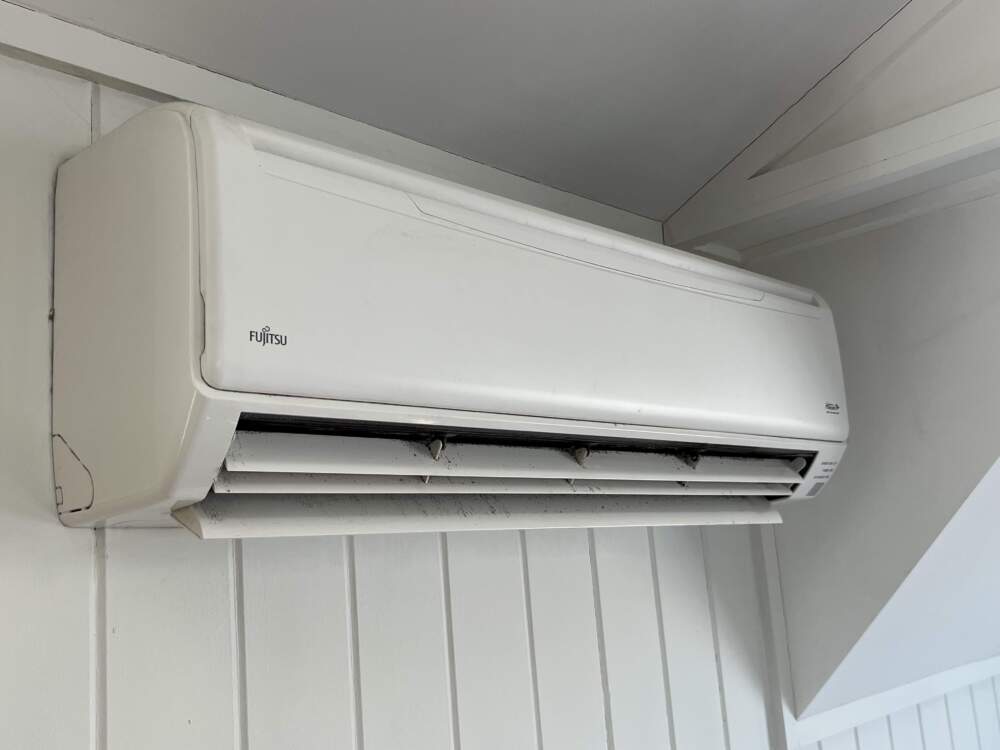
Mini splits are a popular heat pump choice for homes without existing ductwork. (Beth Healy/WBUR)
If you didn’t get your heat pump through Mass Save, or you got it before 2019, signing up will take a little more work. The utilities are still fine-tuning this process, but expect them to ask you for paperwork to verify you have a heat pump, like proof of installation.
How do I sign up?
Unitil customers can enroll by calling customer service or by filling out a customer service form and indicating they’d like to sign up for the Heat Pump Rate. (More details available here.)
National Grid and Eversource customers can’t sign up just yet because the companies are still finalizing their enrollment systems. Both utilities say they expect to have more information about how to sign up this fall. (We’ll update this story when that information becomes available, so check back here.)
Anything else I should know?
If you’ve been thinking about making the switch to a heat pump, you may want to get that process started sooner rather than later. That’s because the tax and spending package signed by President Trump this summer sunsets the federal tax rebates for installing heat pumps at the end of this calendar year.
Before then, if you install an air-source heat pump or a heat pump hot water heater, you can claim a $2,000 credit on your federal taxes. If you install a ground-source heat pump, you can claim up to 30% of the total cost in tax credits.
Though these federal incentives are going away, Massachusetts will continue to offer its own incentives for heat pumps through the Mass Save Program.
New Mass Save rebates for qualifying heat pumps
Below are the rebates available over the next several years. The capacity of a heat pump is measured in tons. For example, a 3-ton system typically can heat or cool a 1,500-square-foot space.
|
Heat pump type and size |
2025 rebate |
2026 rebate |
2027 rebate |
|---|---|---|---|
|
Covers part of your home and uses outside air to heat and cool |
$1,250 per ton |
$1,125 per ton |
$1,000 per ton |
|
Covers your whole home and uses outside air to heat and cool |
$3,000 per ton, up to $10,000 |
$2,700 per ton, up to $9,000 |
$2,500 per ton, up to $8,000 |
|
Covers part of your home and uses a ground, or geothermal, heat source |
$2,000 per dwelling unit |
$2,000 per dwelling unit |
$2,000 per dwelling unit |
|
Covers your whole home and uses a ground, or geothermal, heat source |
$15,000 |
$13,500 |
$12,000 |